
Dirk Gamboa

Phase Interpretation of Quantum Physics

With Quantum Glasses and Quantagrams

Order on Amazon

Quantum Physics as Temporally Organized Physical Effectiveness

Quantum physics is often experienced as an abstract theory of states, probabilities, and measurement outcomes. The Phase Interpretation takes a different approach: it views quantum systems as temporally organized processes. What may otherwise appear as an isolated state becomes visible as a structured progression—with clearly distinguishable phases such as coherence, interaction, and transition.

This creates an understanding that does not begin with equations, but with the temporal structure of physical effectiveness.


About the Book

Many people find quantum physics fascinating—yet difficult to grasp. This book offers a different point of entry: instead of focusing on mathematical equations, it makes the temporal structure of quantum processes visible.

The Phase Interpretation shows how quantum phenomena can be understood as sequences of phases. Through visual models such as Quantagrams and the Quantum Glasses, the dynamics of quantum systems become intelligible—without calculations, yet without sacrificing physical precision.

Thinking in Phases Instead of States

Quantum systems are often described as fixed states. The Phase Interpretation shifts the focus to time. It shows how quantum phenomena unfold in distinguishable phases, making their internal dynamics easier to follow—even without mathematical training.

Making Structure Visible

Instead of presenting formulas, the book reveals how quantum processes are structured. Relations and transitions are organized visually, helping readers see how different elements of a quantum system are connected.

Quantagrams

Quantagrams are visual structure diagrams that represent quantum processes step by step. They transform abstract concepts into structured visual forms, allowing complex phenomena to be understood through their relations.

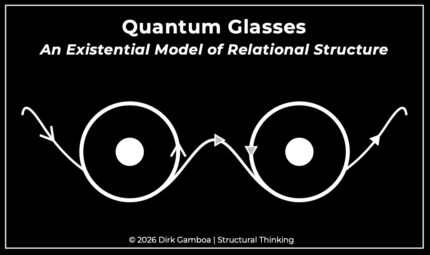
The Quantum Glasses

The Quantum Glasses provide a visual model for observing phase transitions. They help distinguish between coherence, interaction, and transition—making the temporal organization of quantum systems intuitively accessible.

Who this Book Is For

This book is intended for students, educators, physicists, engineers, and anyone who seeks to understand quantum physics structurally and temporally. It is not a problem-solving manual, but a book of interpretation: existing models are not replaced, but complemented by an explicit perspective on their dynamic structure.

Understanding Quantum Physics Visually

Quantum physics is regarded as precise, yet difficult to access. This book opens a new perspective: quantum systems are explained through their temporally organized physical effectiveness. With Quantagrams and the Quantum Glasses, processes are made visually accessible—without mathematical calculations and without conceptual simplification. Coherence, decoherence, and interactions appear as clearly structured phases within an ordered progression.

Quantagrams and the Quantum Glasses

Quantagrams are iconic-structural diagrams that represent quantum processes as ordered relations and transitions. Rather than focusing on mathematical calculation, they make the internal structure of a progression explicitly visible. Dynamics, branching points, and interactions become understandable as an organized pattern.

The Quantum Glasses complement this approach as a visual model for phases and transitions. They make it possible to distinguish coherence, interaction, and transition within a temporally organized process. In this way, quantum physics is not simplified, but rendered structurally readable.

The Quantum Glasses

The Quantum Glasses illustrate how implicit relations can be made explicit. They demonstrate that understanding complex systems does not arise from examining isolated elements, but from making their structural interconnections visible.

Structural Thinking does not add new content; it renders existing relations perceptible in their ordered configuration.

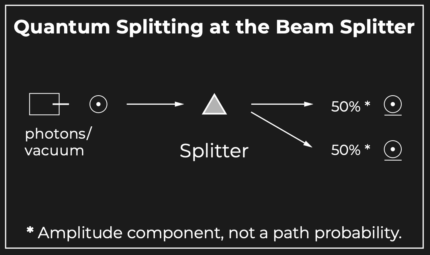
Beam Splitter – Branching of a Coherent Phase

This Quantagram illustrates an elementary quantum process as a temporally ordered structure. When a photon encounters a beam splitter, its amplitude is divided into two coherent components. No two photons are created; instead, two relational branches of a single coherent process emerge.

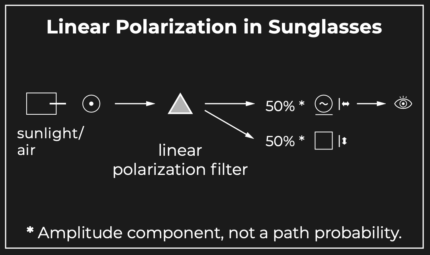
Linear Polarization – Structure of a Filter

This Quantagram shows how light passes through a linear polarization filter. The filter allows only those oscillation components to pass that align with its structure; other components are blocked.

What appears in everyday life as “reduced glare” is physically a structured selection process. The diagram reveals not just the result, but the relational order of this transition.

The Phase Interpretation

A Visual Extension of the Copenhagen Interpretation

The Phase Interpretation does not replace the Copenhagen interpretation. It complements it with an explicit temporal-structural perspective. States become readable as phases within a dynamic progression.

About the Author

Dirk Gamboa is a graduate industrial engineer and the originator of Structural Thinking. With the Phase Interpretation, he applies this perspective to quantum physics, demonstrating how complex processes can be understood visually and structurally. His aim is to make dynamics and physical effectiveness visible as central categories of physical understanding.

Connect on LinkedIn

Contact